ZKML: How Zero-Knowledge Proofs Enable Privacy-Preserving Machine Learning
A bank wants an AI model to assess a transaction without exposing customer data. ZKML offers a way to prove that the model followed the agreed computation without revealing the underlying inputs or model details.
That matters for enterprises handling sensitive financial, health, identity, or proprietary data. This article breaks down how ZKML works, where it fits in privacy-preserving machine learning, and what enterprise teams should consider before adoption.
What Is ZKML and Why Does It Matter?
Machine learning creates a difficult enterprise trade-off. Teams want powerful models, but they cannot freely expose the data or logic behind those models.
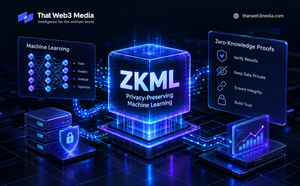
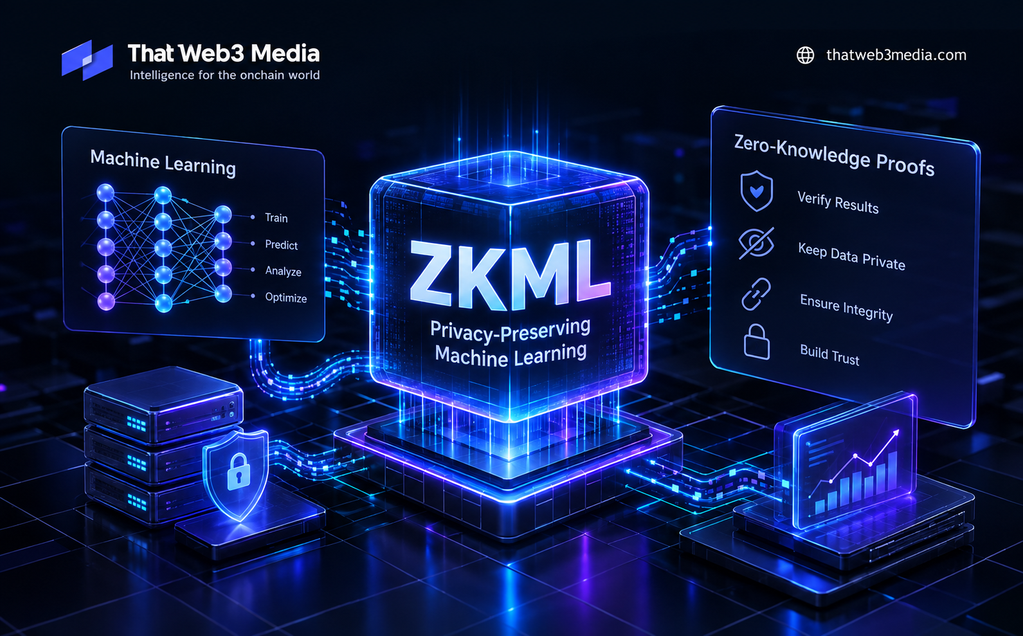
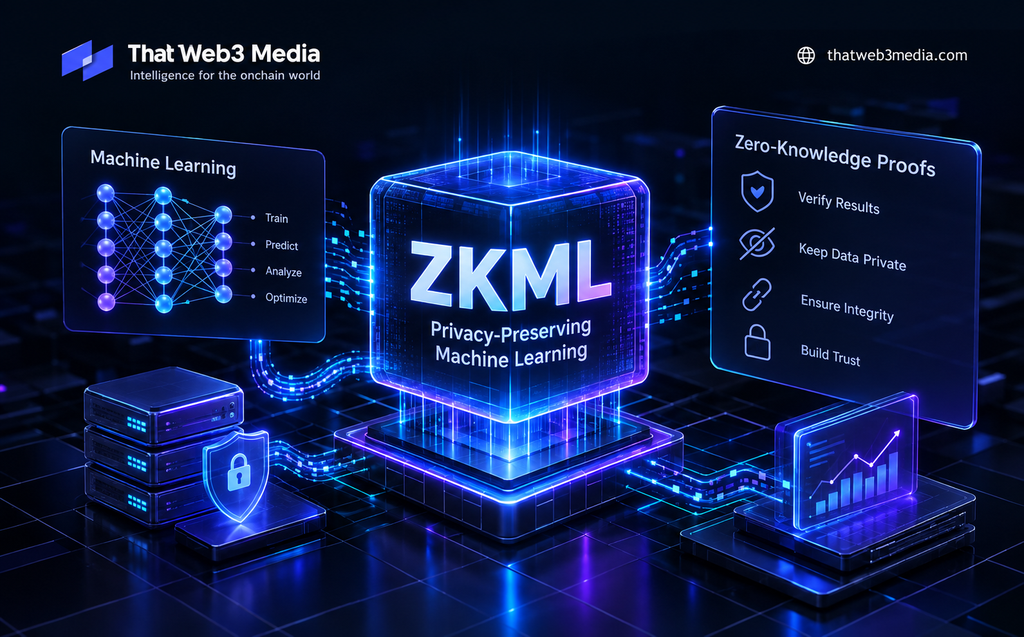
Zero-knowledge machine learning, or ZKML, addresses part of that problem. It combines machine learning with zero-knowledge proofs so one party can prove a computation without revealing all of its underlying information.
A 2025 survey of ZKML research identified three major areas: verifiable training, verifiable inference, and verifiable testing. The research also highlights continuing challenges around efficiency and implementation. (Peng et al., 2025)
The distinction matters for business leaders. ZKML does not simply encrypt an AI model. It creates cryptographic evidence that a specified computation was performed correctly.
Consider a credit-risk provider serving several banks. A bank could submit sensitive information to an external inference service. The provider could return a prediction with a proof that the approved model produced it.
The bank would not need to expose its entire customer dataset to the model operator. The model operator would also have less reason to expose proprietary model weights.
This creates a different trust model for enterprise AI. Instead of trusting a service because of contracts alone, organizations can verify specific computational claims.
How ZKML Enables Privacy-Preserving Machine Learning
The easiest way to understand ZKML is to separate the process into three parts: input, computation, and proof.
Suppose an enterprise sends private data to an external machine learning service. The service runs an agreed model against that data.
The prover then generates a zero-knowledge proof. That proof demonstrates that the computation followed the required rules without revealing every private value used during the process.
The verifier checks the proof. If verification succeeds, the verifier gains cryptographic assurance about the computation.
This approach builds on the broader principle behind zero-knowledge proofs. A prover can demonstrate that a statement is true without revealing unnecessary information about the secret behind that statement.
For machine learning, the statement could be simple: “This output came from this model applied to this input under the agreed computation.”
The model itself can remain private. So can sensitive inputs, depending on the system design.
That makes ZKML relevant to privacy-preserving machine learning, especially where organizations outsource inference. A 2023 survey describes outsourced inference as a trust problem because users need confidence that another party performed the intended computation. (Xing et al., 2023)
The process is not magic, however. The ML computation must be represented in a form that the proof system can handle efficiently.
Neural networks rely heavily on operations such as matrix multiplication, nonlinear activations, and floating-point calculations. ZK systems often require those operations to be translated into proof-friendly arithmetic.
That translation creates engineering overhead. It also explains why ZKML performance remains an important research area.
ZKML vs. Other Privacy-Preserving Machine Learning Approaches
ZKML is not the only method for protecting machine learning workloads. Enterprises should compare it with homomorphic encryption, secure multi-party computation, trusted execution environments, federated learning, and differential privacy.
Each method protects a different part of the machine learning workflow.
Homomorphic encryption allows computation over encrypted data. It can provide strong confidentiality, but computational overhead can remain significant for complex models.
Secure multi-party computation allows multiple parties to jointly compute results without revealing their private inputs. It can work well for collaborative workloads but may introduce communication and protocol complexity.
Trusted execution environments protect computations inside hardware-backed secure areas. They can offer strong practical performance, but organizations must consider hardware trust assumptions.
Federated learning keeps training data distributed across participants. It reduces the need to centralize raw data, but model updates can still create privacy risks.
Differential privacy limits what an output reveals about individual records. It provides a statistical privacy guarantee, but adding noise can affect model utility.
ZKML takes a different route. Its strongest contribution is verifiability.
An enterprise can use ZKML when the question is not only “Was the data protected?” but also “Can we prove that the required computation happened?”
That distinction becomes important for regulated environments. A privacy mechanism can protect data while still leaving uncertainty about whether an external provider followed the approved model.
ZKML can address that verification layer.
The 2025 IEEE survey literature on privacy-preserving deep learning shows why enterprises often need a combination of techniques rather than one universal solution. Current research covers encryption, secure computation, trusted environments, federated learning, and differential privacy. (IEEE Access, 2025)
Where ZKML Fits Into Enterprise AI
Enterprise AI increasingly relies on external infrastructure. Organizations may use cloud GPUs, managed AI APIs, specialized inference providers, or third-party models.
That creates a straightforward governance question: How can an enterprise verify an AI service without exposing everything to the service provider?
ZKML can become part of that verification architecture.
Imagine an insurance company using an external model to assess claims. The insurer wants to keep claim information confidential. It also wants evidence that the provider used the approved model version.
A ZKML system could produce a proof tied to the agreed computation. The insurer could verify that proof without receiving the provider’s proprietary model weights.
This does not eliminate the need for governance. Model approval, data quality, access controls, and audit processes still matter.
ZKML instead strengthens one layer of the control environment: computational integrity.
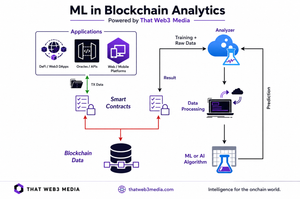
The technology also fits naturally into blockchain-based infrastructure. A blockchain can verify compact cryptographic proofs without storing the underlying private dataset.
That creates a useful division of responsibilities. Sensitive computation can remain off-chain while the blockchain records or verifies the resulting proof.
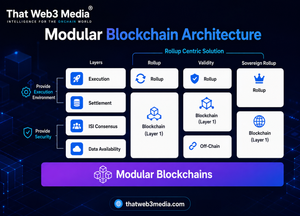
This resembles the broader enterprise design principle behind modular blockchain systems. Enterprises do not need every computation to happen on-chain. They need reliable ways to connect off-chain computation with verifiable on-chain state.
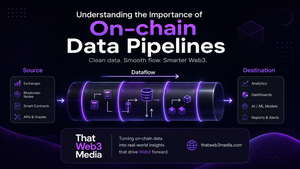
That architecture becomes especially relevant when organizations already use blockchain as a shared coordination layer. It also connects with the infrastructure discussed in modular blockchain architecture and on-chain data pipelines. Our analysis of why enterprises still struggle with blockchain adoption highlights the importance of fitting blockchain into existing business systems rather than treating it as a standalone technology.
ZKML for Financial Services, Compliance, and Risk
Financial institutions represent one of the clearest potential applications for ZKML.
Banks routinely use machine learning for fraud detection, credit scoring, transaction monitoring, and risk assessment. These workloads depend on sensitive customer and transaction information.
A conventional external AI workflow creates a difficult trust boundary. The institution must decide how much data to share with the provider.
ZKML can change that boundary by separating data confidentiality from computational verification.
Consider transaction monitoring. A bank could use a specialized external model to flag suspicious activity. The bank may want evidence that the provider used the approved model and parameters.
A proof could provide that evidence without exposing every internal feature used by the model.
Compliance teams could also benefit from verifiable AI pipelines. A proof does not replace a regulatory audit, but it can create machine-verifiable evidence for a defined computation.
This becomes more relevant as AI governance frameworks mature. Research into ZKP-based machine learning operations has identified a growing focus on correctness, integrity, privacy, and accountability across the ML lifecycle. (Scaramuzza et al., 2025)
There is also a broader enterprise opportunity around confidential collaboration. Multiple institutions may want to use a shared model without giving one another access to proprietary datasets.
ZKML could support parts of that architecture, although secure multi-party computation and federated learning may remain better suited to some collaborative training scenarios.
The right question is therefore not “Can ZKML replace privacy technology?” It is “Where does cryptographic proof add value to the existing privacy architecture?”
The Technical Limits Enterprises Cannot Ignore
ZKML has strong properties, but it remains technically demanding.
The biggest constraint is proof generation cost. A machine learning model can perform millions or billions of operations. Converting those operations into a proof system can create substantial computational work.
Model size also matters. Large neural networks increase the amount of computation that the prover must represent and prove.
Researchers continue to improve this area. For example, ZKTorch reported up to a 6x proving-time speedup over a general-purpose ZKML framework in its evaluated workloads. (Chen et al., 2025)
Another 2026 study introduced zkComposer, which decomposes proof construction into smaller sub-proofs. Its evaluation reported up to 6.84x lower prover time and response time for a GPT-2 workload under one partitioning strategy. (Sanjaya et al., 2026)
These results are encouraging, but they should not be interpreted as universal production benchmarks. Performance depends heavily on the model, proof system, hardware, and implementation.
Model architecture also matters. Some operations map more naturally into proof-friendly arithmetic than others.
Developers may need quantization, fixed-point representations, model simplification, or custom circuits. Those changes can affect accuracy and engineering complexity.
There is another important limitation. ZKML proves the computation defined by the system. It does not automatically prove that the model is fair, useful, unbiased, or trained on high-quality data.
A perfectly verified model can still produce poor decisions.
Enterprise governance must therefore remain broader than cryptographic verification.
What Enterprises Should Consider Before Using ZKML
Before deploying ZKML, organizations should evaluate the technology against a specific business risk.
Define the trust problem first.
Do not begin with the proof system. Identify what the enterprise cannot safely disclose and what it needs to verify. ZKML becomes more useful when both privacy and computational integrity matter.
Choose the right ML stage.
Inference is currently the most mature ZKML use case. Research also covers training and testing, but those workflows can introduce much higher proving costs. (Peng et al., 2025)
Measure proving and verification costs.
Benchmark the full workflow, not only model inference. Include proof generation, verification, memory, hardware, and operational overhead.
Protect the model as well as the data.
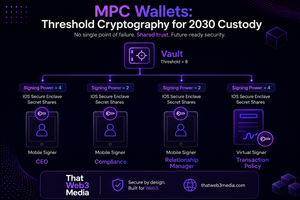
Enterprise models may represent valuable intellectual property. The same principle applies to key management, as discussed in MPC wallet architecture. ZKML can help keep model parameters private, but the complete deployment architecture still needs access controls.
Keep regulatory evidence separate from cryptographic evidence.
A proof can show that a computation followed specified rules. It does not automatically satisfy every regulatory or audit requirement.
Plan for model updates.
AI models change frequently. The proof system must accommodate new model versions without creating an operational bottleneck.
Avoid putting sensitive data on-chain.
Blockchain verification does not mean private enterprise data belongs on a public ledger. Keep sensitive inputs off-chain unless the system has a clear reason to expose them.
Compare ZKML with simpler alternatives.
Some workloads may only need encryption, access controls, secure enclaves, or conventional audit logs. ZKML adds complexity, so the assurance benefit must justify that cost.
The Road Ahead for ZKML
The direction of ZKML is becoming clearer. The field is moving from demonstrating that zero-knowledge proofs can work with machine learning toward making them easier to deploy.
Research is increasingly focused on proof efficiency, model compilation, parallel proving, and production-oriented ML workflows. The 2025 ZKML survey also points to commercial applications while highlighting unresolved implementation challenges. (Peng et al., 2025)
That progress could matter for enterprise AI infrastructure.
Cloud providers and specialized AI platforms may eventually expose verifiable inference as a service. Enterprises could then verify model execution without managing every cryptographic component themselves.
Blockchain networks could provide another layer. They can record proof commitments or verify compact proofs while the underlying AI computation remains off-chain.
This creates a possible architecture for verifiable AI infrastructure. Data stays controlled by its owner. Computation happens where it is efficient. Proofs establish that defined rules were followed.
The practical question is timing.
ZKML is not yet a universal answer for large-scale enterprise AI. Proof generation, model compatibility, tooling, and operational complexity remain meaningful constraints.
However, the underlying business requirement is unlikely to disappear. Enterprises increasingly need AI systems that are not only capable but also private, auditable, and verifiable.
ZKML is one of the cryptographic approaches being developed to meet that requirement.
Frequently Asked Questions About ZKML
What is ZKML?
ZKML stands for Zero-Knowledge Machine Learning. It uses zero-knowledge proofs to verify machine learning computations while limiting disclosure of sensitive inputs or model information.
How does ZKML protect privacy?
ZKML can prove that a specified machine learning computation occurred without revealing all of the private information used inside that computation. The exact privacy guarantees depend on the proof system and implementation.
Is ZKML the same as encrypted machine learning?
No. Encrypted machine learning focuses primarily on protecting data during computation. ZKML focuses strongly on proving that a computation was performed correctly without revealing unnecessary information.
Can enterprises use ZKML today?
Yes, but use cases should be selected carefully. Current research shows meaningful progress, while proof-generation cost, model complexity, and engineering overhead remain important constraints.