MPC Wallets: Threshold Cryptography for 2030 Custody
A single private key, held in a single hardware module, once counted as institutional-grade security. That standard no longer holds. In 2026, wallet compromise remains the largest single category of crypto losses. A lost or stolen seed phrase still means total, irreversible loss of funds.
Enterprises evaluating digital asset custody are asking a harder question than “Is this cold storage?” They want to know whether any single point of failure exists anywhere in the signing process. MPC wallets built on threshold cryptography answer that directly. Instead of one key controlling one signature, signing power gets split across multiple independent parties, and none of them can move funds alone. This article breaks down how MPC and threshold signature schemes work, what the adoption data shows heading into 2030, and how enterprises should evaluate the custody stack they build now.
What MPC Wallets and Threshold Cryptography Actually Are
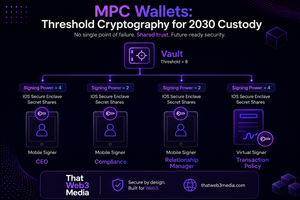
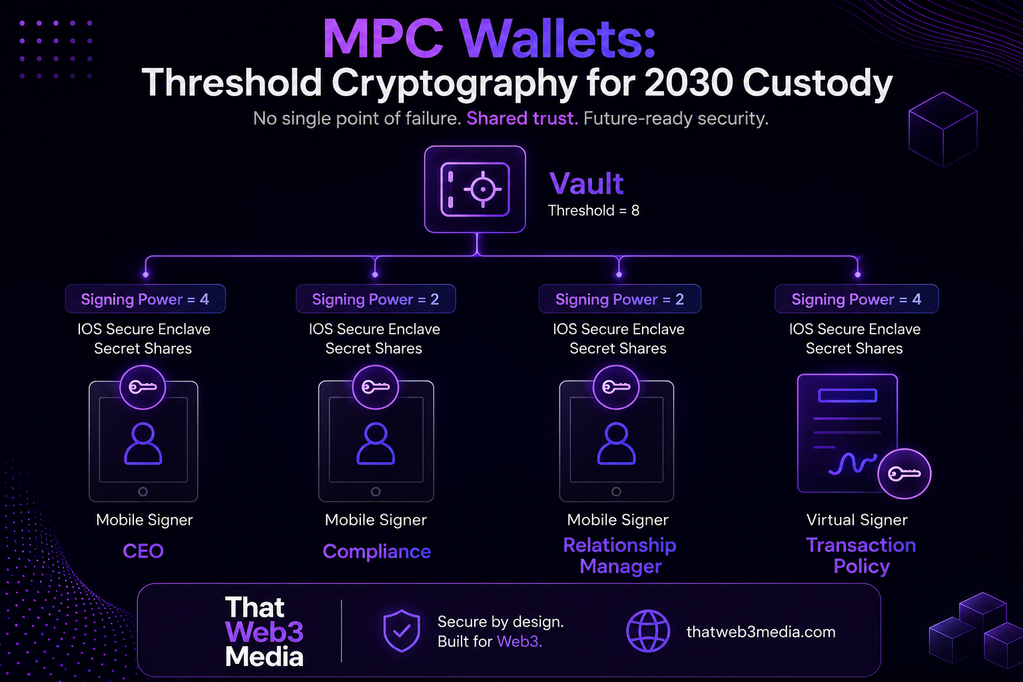
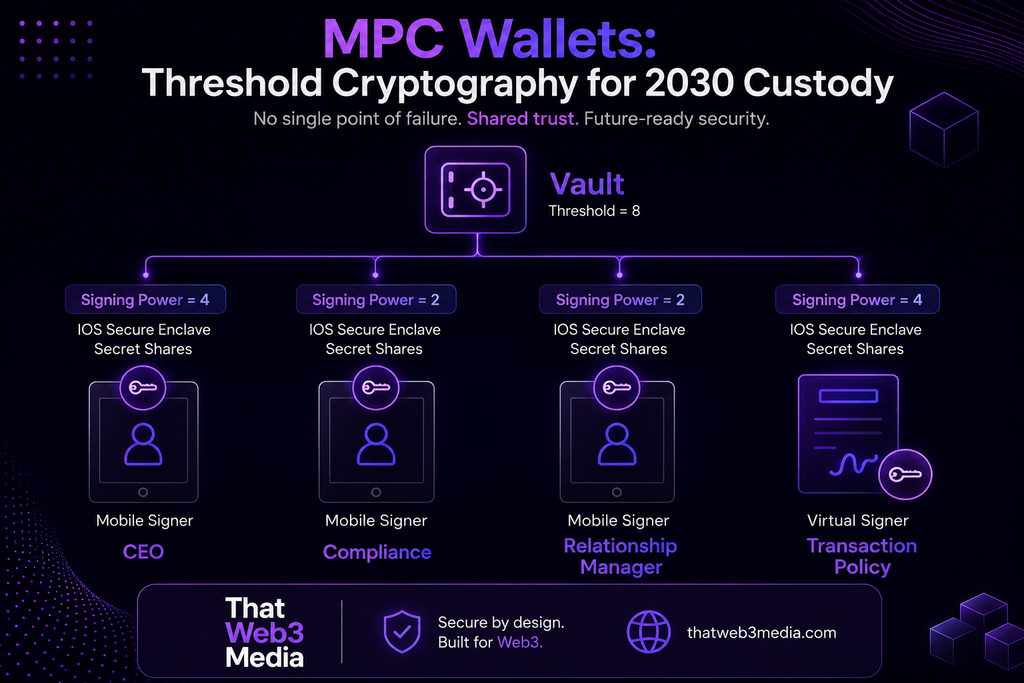
An MPC wallet never generates a complete private key at any single point in time. Multi-party computation splits the signing operation across several parties. Each party holds a mathematical share of the key. A transaction only gets signed when enough parties, meeting a defined threshold, cooperate to compute the signature together.
Threshold cryptography is the discipline that makes this possible. A t-of-n threshold scheme requires any t parties out of n total to participate before a signature can be produced. No party ever sees the full private key. No single device, employee, or data center holds enough information to move funds independently.
This distinction matters more than it sounds. A traditional hardware security module protects one key in one place. If that HSM is compromised, physically stolen, or subject to an insider attack, the key is gone. An MPC wallet spreads that same signing authority across separate, independent shares. Compromising fewer than the threshold number of shares yields nothing usable.
The Data Behind Institutional Custody’s Shift to MPC
The scale of institutional custody is already large and growing quickly. According to a 2026 market report from Research and Markets, the digital asset custody market is valued at 834.29 billion dollars in 2026. It is projected to reach 1.59 trillion dollars by 2030, a 17.6 percent compound annual growth rate.
MPC-specific infrastructure is scaling even faster within that broader market. Research from MarketIntelo puts the global MPC wallet solutions market at 1.4 billion dollars in 2025. It projects the market will expand to 7.8 billion dollars by 2034, a 22.8 percent CAGR. That growth rate outpaces the custody market overall. Institutions are not just adding custody capacity. They are actively replacing older key management architecture with threshold-based systems.
Adoption is already broad among institutional investors. Survey data cited in the same report finds that over 74 percent of institutional investors globally now hold digital assets or are actively evaluating allocation strategies. That scale of participation pushes custody architecture from a technical detail into a board-level risk conversation, one that echoes the broader enterprise blockchain adoption challenges institutions have faced elsewhere.
Concrete deployment numbers back this up. The Fireblocks Trust Company, a NYDFS-regulated qualified custodian built on MPC, has secured more than 10 trillion dollars in digital asset transactions. It manages over 300 million wallets for more than 2,000 clients.
MPC vs. Multisig vs. Threshold Signatures: The Real Differences
These three terms get used loosely, but they describe genuinely different architectures with different tradeoffs. Understanding the distinction matters for anyone designing a custody stack rather than just buying one off the shelf.
Multisig enforces its threshold on-chain. A smart contract or Bitcoin script checks that enough signatures were provided before a transaction executes. The policy is visible to anyone watching the blockchain, which gives auditors an easy way to verify governance without trusting off-chain logs. The tradeoff is cost and privacy. A 3-of-5 P2WSH Bitcoin multisig spend requires roughly 350 virtual bytes per input, and the threshold structure sits exposed on-chain for anyone running chain analysis.
Threshold signature schemes (TSS), including MPC-based ECDSA and Schnorr-based FROST, move that same threshold logic off-chain. The parties compute a signature collaboratively. The result looks identical to a signature from a single key. Verification stays cheap and simple, because the chain has no idea multiple parties were involved. Per Spark’s 2026 Bitcoin custody comparison, a FROST spend via Taproot key-path costs about 57.5 virtual bytes. That is roughly an 80 percent reduction versus a comparable multisig spend.
The practical split enterprises land on reflects real operational differences. TSS suits high-frequency operations, where cost, speed, and confidentiality about internal governance matter most. This is the same reasoning finance teams apply when weighing stablecoin settlement rails against legacy payment infrastructure: speed and cost win once the underlying trust model is proven. Multisig retains an edge for cold, long-term reserves. Regulators and auditors often want a governance structure they can verify directly on-chain, without relying on a custodian’s internal attestations.
FROST and the Move Toward Schnorr-Based Threshold Signing
FROST stands for Flexible Round-Optimized Schnorr Threshold signatures. It represents the newest generation of threshold cryptography reaching production. Chelsea Komlo and Ian Goldberg introduced it in a 2020 paper. By 2026, it has moved from research into standardization.
Bitcoin-specific standardization work is actively underway. BIP-445, assigned in January 2026, specifies a FROST variant compatible with Taproot key tweaking. A companion draft called ChillDKG handles distributed key generation. Together, these give Bitcoin custody a complete, standardized threshold-signing stack for the first time.
FROST’s core advantage over ECDSA-based MPC is a simpler cryptographic foundation. It relies on Schnorr signatures rather than ECDSA, removing the need for Paillier encryption used in many earlier MPC-ECDSA protocols. A simpler foundation means a smaller attack surface. FROST does still have fewer years of production battle-testing behind it than multisig or established MPC-ECDSA implementations. The Zcash Foundation’s FROST library reached stable v3.0.0 in 2026. NCC Group and Least Authority have independently audited it, closing much of that maturity gap.
The likely endpoint for Bitcoin custody specifically is a split by use case. FROST becomes the default for new Bitcoin-native threshold implementations. ECDSA-based MPC persists for multi-chain custody, where EVM and other non-Schnorr networks are involved.
Why Regulators and Insurers Are Standardizing on MPC
Custody architecture has moved from a technical preference to a regulatory checkpoint. Under the SEC’s 2025 no-action letter framework, registered investment advisers and funds must conduct annual due diligence reviews of their qualified custodians. That review explicitly covers the use of hardware security modules, MPC, and other cryptographic protections.
Bank charters are following the same path. BitGo received OCC national bank charter approval in December 2025. It filed for a 200 million dollar NYSE IPO the following month, having already crossed 90 billion dollars in assets under custody. The company runs both multisig and MPC key management, choosing the DKLs23 protocol over Paillier-based alternatives for structural safety reasons.
Insurance markets are pricing this shift directly. Custodians publish probability-of-default assessments that institutional buyers now use to compare counterparty risk, much like comparing bond issuers. As of early 2026, Fidelity Digital Assets, Coinbase Prime, and Komainu rank among the lowest-risk custodians by this measure. That signals threshold-based architecture now factors directly into how the market prices custodial trust.
The Post-Quantum Problem MPC Custody Has to Solve
Threshold cryptography solves the single-point-of-failure problem for today’s signature schemes. It does not automatically solve the next one. Most production MPC systems still rely on ECDSA or Schnorr signatures. A sufficiently capable quantum computer could eventually break both.
The regulatory clock is already running. Executive Order 14412, signed in June 2026, mandates that federal high-value systems transition to post-quantum digital signatures by the end of 2031. NIST’s broader transition guidance deprecates legacy public-key cryptography by 2030 and disallows ECDSA outright by 2035.
Bitcoin’s exposure adds urgency beyond general compliance timelines. Roughly 6.9 million Bitcoin sit in addresses whose public keys are already exposed on-chain. Those coins would become vulnerable the moment a capable quantum computer exists. Custodians cannot fix that exposure at the base protocol layer. They can control how ready their own signing infrastructure is.
Early movement is already visible. BitGo, partnering with Silence Laboratories, completed what both companies describe as the first post-quantum MPC transaction simulation by a regulated custodian. The demonstration integrated NIST’s ML-DSA standard into an existing institutional signing workflow. It mattered less for its novelty and more for what it proved: quantum-resistant signing can slot into custody infrastructure enterprises already operate, without a full rebuild.
Where MPC Wallets Fall Short
MPC eliminates the single-key failure mode. It introduces new operational risks that a hardware wallet or classic multisig setup does not have, and enterprises should evaluate these honestly.
Signing-round abuse is a real attack surface. If a custody stack lacks strict abort rules, malicious disruption of the multi-round communication between signing parties can compromise a transaction rather than simply failing safely. Auditability also works differently than multisig. Every signature presents as if it came from a single key, so external auditors cannot verify governance thresholds directly on-chain. They rely on off-chain logs and vendor attestations instead, which shifts trust rather than eliminating it.
Operational complexity is the tradeoff most enterprises underestimate going in. Key generation, share refresh scheduling, and coordinated recovery across independent parties require more sophisticated infrastructure than a single hardware key ever did. A custody stack without clear answers on refresh cadence and abort logging is not meaningfully safer than the single-key model it replaced.
What Enterprises Should Consider Before Building an MPC Custody Stack
A handful of practical decisions separate MPC deployments that hold up under institutional scrutiny from ones that create a false sense of security.
Protocol selection matched to chain coverage. ECDSA-based MPC remains necessary for multi-chain custody across EVM networks, while FROST fits Bitcoin-native and Schnorr-compatible deployments best. Most enterprises will run more than one protocol rather than standardizing too early.
Share refresh and recovery procedures. Static key shares that never rotate are a long-term liability. Confirm how often shares refresh, how that schedule gets attested, and what recovery looks like if a party becomes unavailable.
Abort-rule discipline. Ask directly what happens when a signing round fails. Repeated aborts should trigger alarms and remediation. They should never allow silent retries an attacker could exploit to probe the system quietly.
Regulatory and insurance alignment. Qualified custodian status, whether through an OCC charter, state trust license, or broker-dealer registration, carries real weight with auditors and insurers. Evaluate a provider’s regulatory footprint alongside its cryptographic architecture, not as a separate checkbox.
Post-quantum migration path. Ask any custody vendor whether their MPC architecture is signature-agnostic enough to adopt post-quantum standards without a full rebuild. Locking into one classical signature protocol while standards are still in transition is a decision enterprises will regret well before 2030.
The Road Ahead to 2030
MPC wallets are not the final form of digital asset custody, and treating them that way misreads where the technology is heading. A layered model is settling into place instead. Threshold cryptography becomes the default signing architecture. FROST handles Bitcoin-native deployments. ECDSA-based MPC covers multi-chain operations. Post-quantum signature schemes arrive as an upgrade path rather than a rebuild.
Regulatory and insurance markets are already pricing this shift in, well ahead of most enterprises’ internal migration timelines. Qualified custodian status, documented share-refresh discipline, and demonstrated post-quantum readiness are becoming the criteria institutions use to separate serious custody providers from ones still running last decade’s architecture. Custody decisions increasingly sit alongside other enterprise infrastructure bets, including how organizations approach autonomous agent payments, where signing authority and spend limits matter just as much as they do for human-controlled treasury wallets.
The open question through the rest of this decade is not whether threshold cryptography becomes the enterprise custody standard. Adoption data already points firmly in that direction. It is which providers manage the post-quantum transition cleanly enough that enterprises never have to explain to a board why their custody architecture became the weak point instead of the safeguard.
Frequently Asked Questions
What is the difference between an MPC wallet and a multisig wallet? An MPC wallet computes a threshold signature off-chain, so the resulting transaction looks like it came from a single key. A multisig wallet enforces its threshold on-chain through a visible script or smart contract, which auditors can verify directly but which costs more in transaction fees and exposes the governance structure to chain analysis.
Is MPC custody safer than a hardware security module? MPC removes the single point of failure that an HSM still has, since no single share can produce a signature alone. It introduces different risks instead, including signing-round abuse and off-chain auditability gaps. The honest comparison depends on how well an institution manages those new operational controls.
Will MPC wallets need to be replaced when quantum computers arrive? Not necessarily rebuilt from scratch, but the underlying signature scheme will need to change. Custodians that design their MPC architecture to be signature-agnostic can adopt post-quantum standards like NIST’s ML-DSA as an upgrade rather than a full infrastructure replacement.
What is FROST and why does it matter for enterprise custody? FROST is a Schnorr-based threshold signature scheme built for flexible, round-efficient signing. It reduces Bitcoin transaction costs by roughly 80 percent compared to equivalent multisig setups and hides governance policy on-chain, making it increasingly the default choice for new Bitcoin-native custody deployments.