On-Chain Data Pipelines: How ETL, Real-Time Indexing, and The Graph Substreams Are Rebuilding Web3 Infrastructure.
A DeFi risk desk cannot wait for a nightly batch job to tell it that a wallet is about to get liquidated. A compliance team cannot reconcile vendor payments against a ledger snapshot that is already six hours stale. Across enterprise finance and treasury, the same realization keeps surfacing: on-chain data pipelines built for yesterday’s reporting cycles cannot support today’s settlement speed.
That gap is why on-chain data pipelines have become one of the fastest-moving categories in Web3 infrastructure. Extract, transform, and load (ETL) processes that once ran in daily or hourly batches are being replaced by streaming architectures. This article breaks down what changed, what the data shows about the shift toward real-time indexing, and how The Graph’s Substreams framework fits into that transition.
What Are On-Chain Data Pipelines
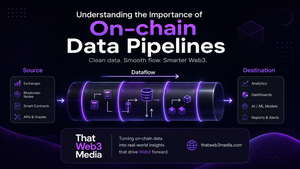
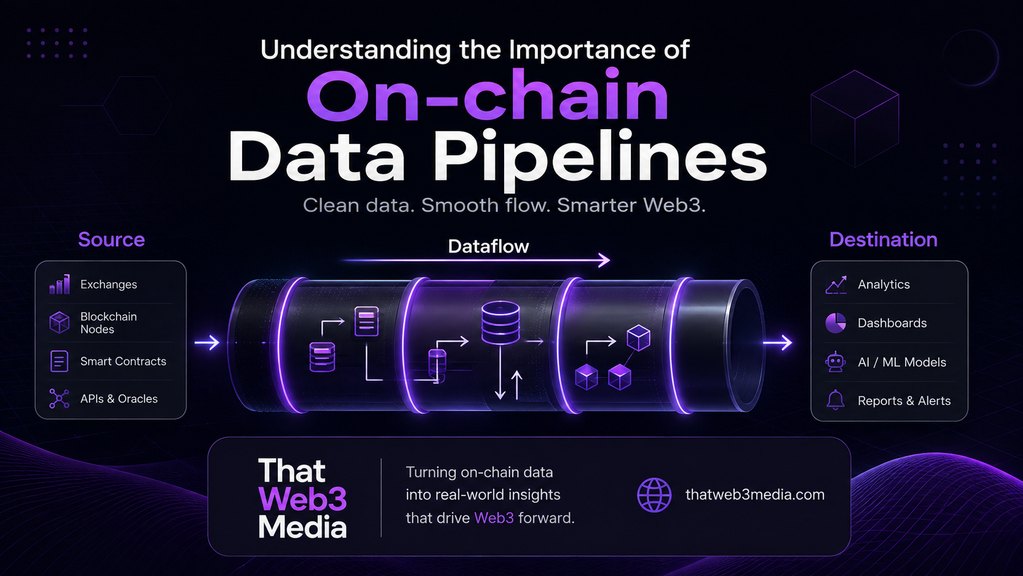
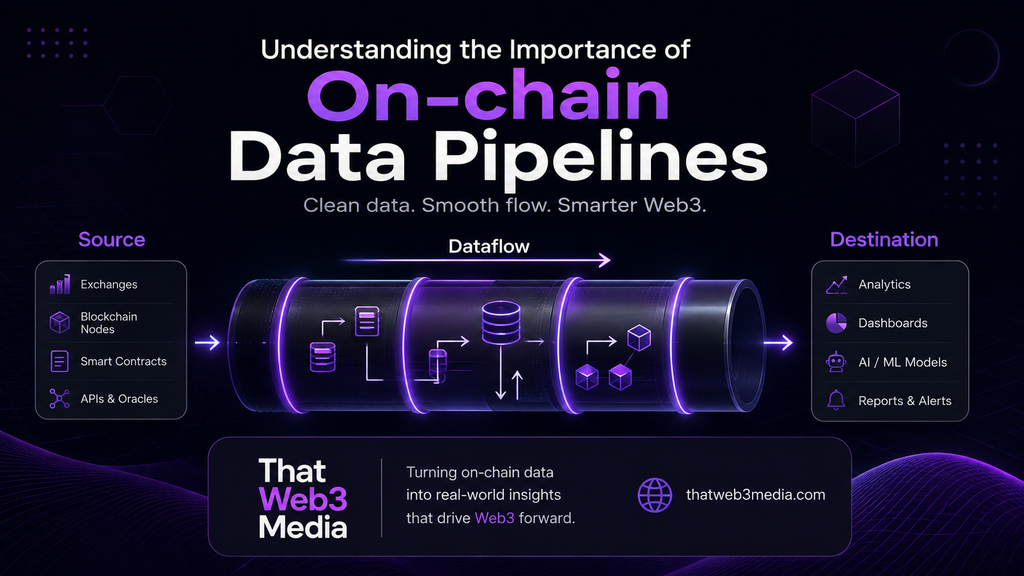
On-chain data pipelines are the systems that pull raw blockchain events, transactions, and state changes, then transform them into structured formats that applications and analysts can actually query. A blockchain node stores data chronologically as blocks. It does not answer business questions like “show every vendor payment settled last quarter” or “flag every wallet approaching a liquidation threshold.” That translation work is what a pipeline does.
Every pipeline follows the same basic shape, borrowed directly from traditional data engineering. Extraction pulls raw data from a node or archive. Transformation decodes contract logs, joins related events, and applies business logic. Loading pushes the result into a database, warehouse, or application. Enterprises evaluating blockchain adoption often underestimate this layer, treating it as a plumbing detail rather than the foundation their entire analytics and compliance stack depends on.
What makes on-chain data pipelines different from traditional ETL is the source data itself. Blockchains reorganize. A block that looked final ten seconds ago can get replaced by a competing chain. A pipeline has to detect that reorg, roll back the affected records, and reprocess them correctly. Traditional data warehouses rarely have to handle a source system rewriting its own history mid-stream.
The Data Behind the Shift to Real-Time Indexing
The market numbers show how quickly this category is scaling. According to a 2026 market report from Research and Markets, the Web3 data indexing platforms market grew from 2.12 billion dollars in 2025 to 2.68 billion dollars in 2026. The same report projects it will reach 6.77 billion dollars by 2030. That works out to a 26.1 percent compound annual growth rate.
Adoption at the protocol layer backs up that trajectory. The Graph’s 2026 technical roadmap reports that the network has served more than 1.27 trillion queries to over 75,000 projects as of early 2026. That volume did not come from batch reporting jobs. It reflects applications and enterprises pulling on-chain data pipelines that respond in real time, not on a daily refresh schedule.
Growth is not evenly distributed. Real-time streaming and multi-chain synchronization are consistently cited as the leading demand drivers, ahead of general blockchain analytics. Enterprises are not simply asking for more historical data. They are asking for the same data, delivered faster and with fewer manual reconciliation steps.
From Batch ETL to Streaming: Why the Old Model Broke
Traditional blockchain ETL followed a familiar batch pattern. A script would query a node periodically, decode new events since the last run, and write the results to a database. This worked reasonably well when transaction volumes were low and use cases were mostly historical reporting.
Three pressures broke that model. Transaction volume grew faster than single-threaded extraction jobs could keep pace with. Layer-2 networks and non-EVM chains multiplied the number of sources a single pipeline needed to cover. Use cases shifted from retrospective reporting toward live risk monitoring, where a stale read is functionally the same as no read at all.
Sequential processing became the clearest bottleneck. A batch job that decodes one block at a time cannot parallelize easily, because later blocks sometimes depend on state established earlier. Reorg handling made this worse. A naive pipeline has to pause, detect the fork, and reprocess a range of blocks, which stalls the entire extraction queue.
Streaming architectures solve this differently. Instead of polling a node on a schedule, a streaming pipeline subscribes to a continuous feed of block data. It processes events as they arrive rather than in scheduled batches. Reorgs get handled as stream corrections rather than full pipeline restarts, which keeps downstream consumers closer to real time.
How The Graph Substreams Changes On-Chain Data Pipelines
Substreams is The Graph’s answer to the batch ETL bottleneck. According to The Graph’s official documentation, Substreams is a parallel blockchain indexing technology designed to boost performance and scalability beyond what sequential indexing can achieve. Rather than processing blocks one at a time, it splits historical block ranges into segments and processes them concurrently.
That parallelization changes what an on-chain data pipeline can realistically deliver. A backfill that once took days can complete in hours because multiple workers extract and transform different block ranges simultaneously. Developers write custom transformation logic once, in Rust, and apply it across any supported chain rather than rebuilding extraction logic per network.
Substreams also breaks the assumption that pipeline output has to feed a single destination. Its multi-sink model can route decoded data into a subgraph, a Postgres database, ClickHouse, or MongoDB. Enterprises get to keep their existing analytics stack instead of migrating everything into one proprietary query layer. The Graph’s Horizon upgrade announcement frames Substreams as the layer built for “enterprise-scale projects with parallelized data processing.” It sits alongside Subgraphs, Token API, and compliance-oriented services under one modular protocol.
Multi-chain coverage extends the same logic beyond Ethereum-compatible networks. Substreams supports Solana, Injective, Starknet, and Vara alongside standard EVM chains, giving a single pipeline architecture reach across ecosystems that would otherwise require separate custom indexers.
Substreams vs. Subgraphs vs. Traditional Indexers
Choosing an indexing approach comes down to matching the tool to the query pattern, not picking a single “best” option. Subgraphs and Substreams solve related but distinct problems within The Graph ecosystem, and both differ from the custom indexing frameworks and pre-built data APIs enterprises often start with.
Subgraphs expose a GraphQL API built for relational, application-facing queries. They answer questions like “which pools has this wallet provided liquidity to,” where the value comes from mapped relationships between entities. Frontend teams building user-facing dApps generally reach for Subgraphs first.
Substreams are built for high-throughput extraction and transformation, feeding filtered, decoded data directly into a database of the enterprise’s choosing. They fit large-scale on-chain data pipelines destined for a data warehouse rather than a single application’s API.
Custom indexing frameworks, such as self-hosted alternatives, give developers full control over schemas and handler logic. That flexibility comes with more operational overhead. Teams have to manage scaling, monitoring, and reorg handling themselves rather than relying on a managed protocol.
Pre-built data APIs, like read-only analytics platforms, expose already-indexed data without letting developers define custom extraction logic. They work well for exploratory analysis but rarely fit a compliance workflow that needs a defensible, auditable data lineage.
Where Real-Time Indexing Delivers the Most Enterprise Value
Not every workload needs sub-second freshness, but several categories genuinely break without it.
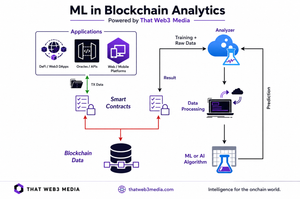
- DeFi risk monitoring. Liquidation and collateral models depend on knowing a wallet’s position now, not six hours ago. A pipeline lagging behind live state produces false confidence, not just delayed insight. That Web3 Media’s coverage of ML in blockchain analytics explores this problem in more depth around liquidation prediction.
- Prediction markets and trading platforms. Real-time indexing powers order matching, open interest tracking, and leaderboard updates that users expect to update instantly.
- Treasury and settlement reconciliation. Finance teams settling vendor payments through stablecoin rails need transaction confirmation data that matches their treasury system in near real time, not at the next batch cycle.
- Machine-to-machine and agent commerce. Autonomous agents transacting on-chain generate volume and pacing that manual batch reconciliation simply cannot track, a pattern already visible in how enterprises are approaching agent payment infrastructure.
One infrastructure provider illustrates the throughput bar these use cases set. Goldsky reports processing more than 100 million events per minute while maintaining 99.9 percent uptime for a live prediction market platform. That figure gives a useful benchmark for what “real-time” actually means at production scale, well beyond what a scheduled batch job could sustain.
The Competitive Landscape for On-Chain Data Pipelines
The category has diversified well beyond a single indexing standard. Chain coverage varies significantly across providers. According to benchmark research from Envio, SubQuery supports over 300 chains, including non-EVM networks such as Polkadot and Cosmos. Subsquid covers more than 100 chains, and Goldsky supports around 150.
Positioning differs as much as coverage does. Some providers focus narrowly on event extraction and pipeline delivery, leaving reorg handling and state reconstruction to the client application. Others prioritize managed, application-facing indexing with less configuration required upfront. Enterprises typically end up running more than one tool: a managed service for application queries and a Substreams-style pipeline for warehouse-scale analytics.
Pricing and operational models split along a similar line. Fully managed platforms reduce infrastructure overhead but limit customization. Self-hosted frameworks offer full control at the cost of ongoing DevOps investment. Enterprises evaluating this landscape should treat it less like choosing a winner and more like assembling a stack, matching each workload to the pipeline architecture built for it.
What Enterprises Should Consider Before Building On-Chain Data Pipelines
A handful of practical decisions separate on-chain data pipelines that hold up under production load from ones that quietly drift out of sync with the chain.
Reorg handling as a first-class requirement. Any pipeline that treats reorgs as an edge case will eventually produce incorrect data during a live event. Confirm how a provider detects and corrects forked blocks before committing to it.
Latency budgets matched to the use case. A quarterly reporting pipeline can tolerate hourly batches. A liquidation monitor cannot. Define the acceptable staleness window for each workload before selecting an architecture, rather than defaulting to the fastest option everywhere.
Multi-sink flexibility. Enterprises rarely want to migrate their entire analytics stack to adopt one indexing tool. Prioritize pipelines that can route decoded data into existing databases like Postgres or ClickHouse instead of a proprietary query layer only.
Auditability and data lineage. Compliance and finance teams need to trace a number in a dashboard back to the exact transaction that produced it. Pipelines built without clear provenance create real friction during an audit.
Multi-chain coverage aligned to actual usage. Chain support numbers look impressive in a vendor comparison, but only the chains an enterprise actually transacts on matter. Match coverage to real usage rather than the largest number on a features page.
The Road Ahead
On-chain data pipelines are not converging toward one dominant standard, and that outcome looks unlikely to change soon. Subgraphs, Substreams, custom frameworks, and pre-built APIs are settling into complementary roles rather than competing head-to-head for every use case.
What is consolidating is the underlying expectation. Batch ETL built for daily reporting is giving way to streaming architectures built for continuous state. Enterprises adopting real-time indexing are not chasing a technical upgrade for its own sake. They are matching their data infrastructure to settlement speeds that already moved past what nightly jobs can track.
The open question through the rest of 2026 is less about which indexing technology wins and more about integration. Substreams is moving further into The Graph’s Horizon protocol, and competing providers keep expanding chain coverage. Enterprises will increasingly judge on-chain data pipelines by how cleanly they plug into compliance and treasury workflows, not by raw throughput numbers alone.
Frequently Asked Questions
What is the difference between blockchain ETL and traditional ETL? Blockchain ETL has to account for chain reorganizations, where recently confirmed data can be replaced by a competing fork. Traditional ETL sources rarely rewrite their own history, so on-chain data pipelines need reorg detection and correction logic that standard ETL tools do not.
Are Substreams a replacement for Subgraphs? Not exactly. Substreams handle high-throughput extraction and transformation into external databases, while Subgraphs serve relational, application-facing GraphQL queries. Many teams run both, using Substreams to power a Subgraph or a separate warehouse pipeline simultaneously.
How fast can real-time indexing actually get? Production examples vary by provider and chain, but some infrastructure platforms report processing over 100 million events per minute at 99.9 percent uptime for live applications like prediction markets. Most enterprise use cases need far lower throughput than that ceiling.
Do enterprises need to build custom on-chain data pipelines, or can they use a managed service? It depends on the workload. Managed platforms reduce operational overhead and suit teams without dedicated blockchain infrastructure engineers. Custom pipelines make sense when an enterprise needs full control over schema design, transformation logic, or data residency for compliance reasons.